Why Consistent Data Collection Matters
Published July 15, 2026 • Charity Check Resources
By the Charity Check Team
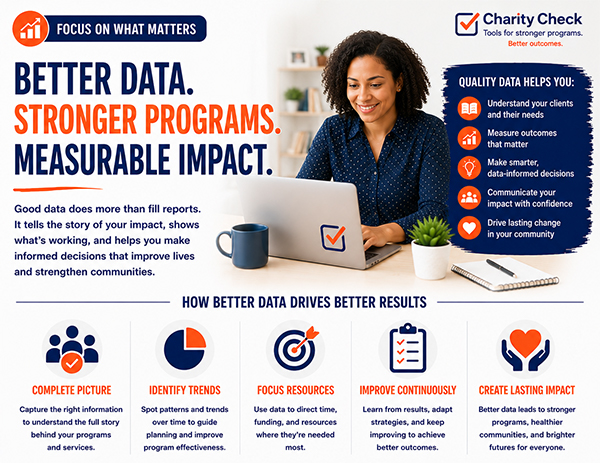
Most nonprofit organizations collect data every day.
Case notes are entered, assessments are completed, services are recorded,
and reports are generated. Over time, this information becomes one of an
organization's most valuable assets.
However, data is only useful if it is collected consistently.
When different staff members record information in different ways,
organizations may struggle to trust their reports, identify trends,
or demonstrate impact. Even small inconsistencies can create challenges
that grow over time.
Consistent data collection helps ensure that information is reliable,
meaningful, and useful for decision-making.
Key Takeaway:
Consistent data collection improves reporting accuracy,
strengthens decision-making, and helps organizations
demonstrate impact with confidence.
Why Consistency Matters
Data is often used for much more than day-to-day operations.
Organizations rely on information to:
- Report to funders
- Evaluate program effectiveness
- Support strategic planning
- Demonstrate community impact
- Identify trends and opportunities
When data is collected consistently, reports become more accurate
and trustworthy.
When it is not, organizations may spend significant time correcting
errors, reconciling conflicting information, or explaining
unexpected results.
Reliable Reports Start with Reliable Data
Every report is only as accurate as the information used to create it.
Consistent data collection helps ensure that staff are recording
information using the same definitions, processes, and expectations.
When everyone follows the same standards, reports become much
more meaningful.
Common Causes of Inconsistent Data
Many organizations do not intentionally create inconsistent records.
Instead, inconsistencies often develop gradually as programs grow
and staff responsibilities change.
Different Interpretations
Staff members may interpret questions differently or use different
criteria when recording information.
Without clear guidelines, similar situations can produce
very different records.
Incomplete Information
Missing fields, skipped assessments, and incomplete case notes
can create gaps that affect reporting accuracy.
Over time, these gaps make it more difficult to understand
program performance.
Changing Processes
Organizations often improve procedures as they grow.
However, if changes are not documented and communicated clearly,
staff may continue using older methods.
Benefits of Consistent Data Collection
Improved Reporting
Consistent data produces cleaner reports and more reliable
outcome measurements.
Staff spend less time correcting information and more time
analyzing results.
Better Decision-Making
Leadership teams depend on accurate information when making
program and funding decisions.
Reliable data provides confidence that decisions are based
on actual trends rather than incomplete information.
Stronger Grant Reporting
Funders increasingly expect organizations to demonstrate
measurable impact.
Consistent data collection makes it easier to produce reports
that accurately reflect program outcomes.
Greater Staff Confidence
When employees trust the information they are entering and
reviewing, they are more likely to use data as part of
everyday decision-making.
Remember:
Data quality is not just a reporting issue. It influences planning,
funding, service delivery, and organizational credibility.
Best Practices for Improving Data Consistency
Establish Clear Definitions
Ensure staff understand exactly what each field, assessment,
and measurement represents.
Written standards help reduce confusion and improve consistency.
Train Staff Regularly
Even well-designed processes require reinforcement.
Ongoing training helps maintain consistency as teams grow
and responsibilities change.
Review Data Frequently
Regular reviews help identify issues before they become
larger problems.
Small corrections made early can prevent significant
reporting challenges later.
Use Standardized Assessments
Standardized tools help ensure that information is collected
consistently across staff members, programs, and reporting periods.
Technology Can Help
Many nonprofits begin by collecting information using spreadsheets,
paper forms, or multiple disconnected systems.
As organizations grow, maintaining consistency becomes
increasingly difficult.
A centralized client management system can help organizations:
- Standardize data collection
- Reduce duplicate entry
- Improve reporting accuracy
- Track outcomes consistently
- Support organization-wide reporting standards
Technology alone does not guarantee quality data, but it can
make consistent processes easier to implement and maintain.
Final Thoughts
Consistent data collection is the foundation of meaningful
reporting and outcome measurement.
When organizations establish clear processes, train staff
effectively, and review information regularly, they create
data that can be trusted.
Reliable data helps nonprofits demonstrate impact,
improve services, support funding efforts, and make informed
decisions that strengthen their mission.
Ready to Improve Data Quality?
Learn how Charity Check helps nonprofit organizations
standardize data collection, improve reporting accuracy,
and track outcomes with confidence.
Learn More